A Perpetually Shifting System of Parasites
“Under The Real, in contradistinction to these runaway overdetermined signs, lies the impossible experience of the plenum. The real stands for literal meaning (as opposed to literal uses of meaning, which are always possible). In so far as no experience of the real is possible (experience is the consequence of the interaction between imaginary identifications and symbolic signification) it stands for the impossible. The ideal, beyond signification, which stands in for the fact that there is no real relation, is the non-relational possibility itself, or just death. We can fairly clearly see, I think, that relations of any kind are only possible through certain kinds of signification. In terms of desire, the proximal relation (I just want to get next to you) blots out signified meaning in favour of contiguous relation (pure chance in its extreme form, which is a little disconcerting for those who are waiting for Mr Right). This is perhaps best experienced as a kind of jouissance (ecstatic enjoyment) or petit-mort (little death, a colloquialism for orgasm). In terms of the symbolic, relations are overdetermined by many permutations of social identification, including gender, class, position, status etc. Anything like a real relation is of course impossible, as is a pure symbolic or pure imaginary relation. Everything seems to appropriate bits of everything else like a perpetually shifting system of parasites with no non-parasitical host. Everything to a certain extent depends upon something of its others.” [1.]
The Sleep of Reason gives Birth to Monsters
Because tvrannical desires are thus more or less "inhibited." their existence is evinced above all in dreams, the "sovereign route" to knowing what law, reason or better desires censor in the waking state - during sleep, to degrees proportionate to the strength or weakness of each person's repression, forbidden desires awaken as reason falls asleep. The mechanism described by Plato by which the inhibited returns anticipates Freudian description and metapsychology at every point. It is because, during sleep, the authority of supervision (Freud calls it the conscious mind or the superego; Plato, the careful, reasoning part of the soul, ready at the command: the intellect) - these sentinels and guardians of reason, known as good principles (cf. 560a and 591a) - slacken and rest; repressed desires are give free reign to satisfy their appetites; "the sleep of reason gives birth to monsters ...."
What is the difference between a structure and a process?
“Don’t make structures, set processes going.”
- John Cage
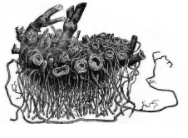
Image: http://www.inflexions.org/n1_t_nguihtml.html Quote: Deleuze & Guattari, A Thousand Plateaus, p18
What is the difference between a structure and a process?
STRUCTURE: 1. the action of building 2a. something that is constructed 2b. something arranged in a definite pattern of organization 3. manner of construction 4a. the arrangement of particles or parts in a substance or body 4b. organization of parts as dominated by the general character of the whole 4c. coherent form or organization 5. the aggregate of elements of an entity in their relationships to each other.
PROCESS: 1a. PROGRESS, ADVANCE 1b. something going on : PROCEEDING 2a. a natural phenomenon marked by gradual changes that lead toward a particular result 2b continuing natural or biological activity or function 2c. a series of actions or operations conducive to an end 3. a prominent or projecting part of an organism or organic structure
To differentiate between a structure and a process is therefore to understand that a process is something continuous, it is not fixed or static, but consists of a ‘going on’, a continuing, a series of actions that demonstrate gradual changes. A structure, on the other hand, is ‘definite’, it is an aggregate of many parts and is considered as a whole; the whole being defined by whatever is dominant in the structure’s general character.
PROCESS PHILOSOPHY is based on the premise that being is dynamic and that the dynamic nature of being should be the primary focus of any comprehensive philosophical account of reality and our place within it. Even though we experience our world and ourselves as continuously changing, Western metaphysics has long been obsessed with describing reality as an assembly of static individuals whose dynamic features are either taken to be mere appearances or ontologically secondary and derivative. For process philosophers the adventure of philosophy begins with a set of problems that traditional metaphysics marginalizes or even sidesteps altogether: what is dynamicity or becoming—if it is the way we experience reality, how should we interpret this metaphysically? Are there several varieties of becoming—for instance, the uniform going on of activities versus the coming about of developments? Do all developments have the same way of occurring quite independently of what is coming about? How can we best classify into different kinds of occurrences what is going on and coming about? How can we understand the emergence of apparently novel conditions? Process philosophers claim that there are many sound philosophical reasons to take the processual aspects of nature, cognition, and action as fundamental features of the real.
“There is one term of the problem which you are not taking into account: precisely, the world. The real. You say: the real, the world as it is. But it is not, it becomes! It moves, it changes! It doesn’t wait for us to change.. .It is more mobile than you can imagine. You are getting closer to this reality when you say as it 'presents itself'; that means that it is not there, existing as an object. The world, the real is not an object. It is a process.”[1] - John Cage
The Structure of the Real (Lacan): “The Order which comes before every Symbolisation or Imagination is called the Order of the Real. The Real is barred from the Symbolic Order but it also makes the Symbolic Order possible as it calls for an endless flux of signifiers to generate meaning. The signifiers constantly try to signify the Real in the Symbolic Order. Paradoxically, it will never be possible to put it into words completely: a gap will remain. The arrows do not indicate a causal relation, but a process of Symbolisation. Through the object a, the Symbolic Order refers back to the Real Order. It is the place where the 'brokenness' of the subject ,where the gap in the Symbolic Order becomes apparent. For Lacan, this is typically situated in the openings of the body. The voice and the mouth are therefore examples par excellence of the object a. Through his look and through his voice the subject gets in touch with others. But at the same time, he loses his look or his voice: he can never see or hear it himself. Thus the price that has to be paid for communication/Symbolisation is the loss of the primordial object a, at which the subject's desire is pointed. In sum, we can say that the Real is that which comes before Symbolisation, and which provokes desire. When it is approached too closely, it is a horrifying reality, but it also makes Symbolisation possible”.
“Music becomes meaningful the more perfectly it defines itself in this sense—and not because its particular elements express something symbolically. It is by distancing itself from language that its resemblance to language finds its fulfillment”. - Adorno
“In order for music to free itself, it will have to pass over to the other side - there where territories tremble, where the structures collapse, where the ethoses get mixed up, where a powerful song of the earth is unleashed, the great ritornelles that transmutes all the airs it carries away and makes return.” [2] - Deleuze
“Consciousness needs to be redefined accordingly in terms of flows of variations, constantly transforming within patterns of continuity. The old mind–body liaison needs to be reconstructed in terms which are not nationally driven, top-down and hierarchical. Processes, flows, in-between-status have to be taken into serious account, that is, into conceptual representation. Continuities and discontinuities alike need to be considered. Internal complexities and non-sequential effects have to be accepted in the order of our thought. To live up to these complexities, we need conceptual creativity and a healthy, non-nostalgic detachment from traditional beliefs about what counts as ‘the knowing subject’”. -Rosi Braidotti
For both statements and desires, the issue is never to reduce the unconscious or to interpret it or to make it signify according to a tree model. The issue is to produce the unconscious, and with it new statements, different desires: the rhizome is precisely this production of the unconscious
“A rhizome as subterranean stem is absolutely different from roots and radicles. Bulbs and tubers are rhizomes. We should stop believing in trees, roots, and radicles. They’ve made us suffer too much”. A rhizome is a “multiplicity” not a multiple. There is no absolute “one” for which we can trace it back to. [3]
"Multiplicity remains completely indifferent to the traditional problems of the multiple and the one, and above all to the problem of a subject who would think through this multiplicity, give it conditions, account for its origins, and so on. There is neither one nor multiple, which would at all events entail having recourse to a consciousness that would be regulated by the one and developed by the other" -Deleuze
[1.] Quote in 'John Cage, For the Birds: John Cage In Conversation with Daniel Charles', London/New York: Marion Boyars, 1981; as quoted in: 'Tàpies: From Within', June ─ November, 2013 - Press Release, Museu Nacional d’Art de Catalunya (MNAC ), p. 17, note 10
[2.] "Essays critical and clinical" by Gilles Deleuze, (p. 104), 1993.
[3.] Deleuze & Guattari,, A Thousand Plateaus, p7- p15
On Movement as the Essential Tool for the Creation New Forms
CONSCIOUSNESS cannot spontaneously accept or reject new forms, as offered by creative genius; it is the new form, for however great a period of time it may remain a mere irritant—that molds consciousness to the necessary amplitude for holding it. - Mina Loy
Is new form aggressive by nature? Newness is a shock and no matter how gentle, round or pretty- it is a disturbance, a collision, always requiring an expansion. Expansions, no matter how slight, stretch- and stretchings hurt. Mina Loy said that new form molds consciousness- form comes first. Forms break and bleed. They antagonize consciousness until consciousness expands. Shift your position and the whole world is new. Stop staying in locations already familiar. What is movement anyways but a changing of position, a repeated changing of positions. I want my paintings to do it. I want them to move and be moved, to be moved by moving and to be moving having been moved.
Life is a process of becoming, a combination of states we have to go through. Where people fail is that they wish to elect a state and remain in it. This is a kind of death. -Anais Nin
Haraway situates subjectivities- ‘cuz no one is without location. What is your vantage point, your advantage point? What can possibly clear the rooted matter that solidifies vision? My vision is multiple and many- doubled, tripled, troubled. AND form hurtling against itself is thrown beyond the synopsis of vision. Haraway: ‘only partial perspective promises objective vision’. Being partial means never quite fitting. To be dis-located requires confidence in knowings that only come from having been being so fully. Fully being is a rarity- I provoke you to come out and begin it. The velocity of velocities arrives in starting.
Fuck waiting for starting and start that shit now. Evolution requires movement and forms evolve sometimes slowly and always through multiple and ugly moments. Let your shit be ugly. Just fuck it all to hell and make something. I’m sick of restriction and restraint- of holding it in thinking I’ll let it out later. Locomotion is key to sex and movement breeds the new. So fuck it!

VECTOR
Noun
(n) vector a variable quantity that can be resolved into components)
(n) vector a straight line segment whose length is magnitude and whose orientation in space is direction
(n) vector, transmitter any agent (person or animal or microorganism) that carries and transmits a disease
(n) vector (genetics) a virus or other agent that is used to deliver DNA to a cell
The velocity of velocities arrives in starting
To make a diary of aesthetics- to document my aesthetic evolution and construct an aesthetic manifesto that frames my practice and potentially contributes to the fields of aesthetics and painterly inquiries. Waiting for and conjuring inspirations - movements that take a picture, a concept forward. This is the goal of this writing. It is an attempt to outline a potential formula for the creation of new forms, if such a thing is at all possible.
But first, several definitions come to mind that will need to be made clear:
FORM -the visible shape or configuration of something; a particular way in which a thing exists or appears; a manifestation; bring together parts or combine to create (something); make or fashion into a certain shape or form.
NEW - not existing before; made, introduced, or discovered recently or now for the first time; not previously used or owned; of recent origin or arrival; already existing but seen, experienced, or acquired recently or now for the first time; unfamiliar or strange to (someone); just beginning or beginning anew and regarded as better than what went before; reviving another or others of the same kind; superseding another or others of the same kind, and advanced in method or theory.
AESTHETIC/S - concerned with beauty or the appreciation of beauty; giving or designed to give pleasure through beauty; of pleasing appearance; a set of principles underlying and guiding the work of a particular artist or artistic movement.
MOVEMENT-an act of changing physical location or position or of having this changed; the activities and whereabouts of someone during a particular period of time; a change or development; a group of people working together to advance their shared political, social, or artistic ideas; an act of defecation.
To define something is to give it form. Much like painting defines its shapes, terms have shape too. I hope to give shape to new or re-contextualized terms as much as I hope to generate new or re-contextualized forms. A text has a form and Cixous knows. A text performs her form and Cixous knew. A poetic inquiry into the unconscious of a still young naive painter. I’m looking for something, and I have the patience to wait. I have the gumption to struggle with it, for it.
I don’t want it to fit into any one singular canon- the writing, the painting. You know, single vision is worse than double vision or many headed monsters (Haraway). I don’t want it to be easily located on a plot point. Maps show territories already determined. My map is still being made. My location is totally uncertain. I use uncertainty and dislocation as an ally in discovering what it means and what it can be to make paintings in a totally territorialized, squelched and forsaken contemporary art world. I don’t really want to be found, I don’t want to be plotted, planted or stuck. Freedom of movement is by all means the essential element in (re)producing (new) forms. Obscurity is a friend. The body in gestation is off the map- you are doubled and you are waiting. The painter lives in a state of gestation- waiting for her due date.
Deleuze wanted us to “Bring something incomprehensible into the world!” What could be more incomprehensible than self-willed waiting, continuous gestating, and/or the total agony of creating…
Can a state of being be a thing in the world?
I can’t be objective. I am totally in it.
Image: FF Runge
Movement is the law that generates new forms
“Movement is the law that generates new forms. Morphology is the principle of such movement. Morphology is both spatial, in its study of the relations of parts, and temporal, in its examination of development through time” - Esther Leslie, Synthetic Worlds. p59
“Rather if we actually contemplate all the existing forms [Gestalten], especially the organic ones, nowhere do we find anything stable, at rest, or complete and detached; rather we find that everything fluctuates in constant flux” - Goethe, quoted in Synthetic Worlds, p59
“Feminist actionism seeks to transform the object of male natural history, the material “woman” subjugated and enslaved by the male creator, into an independent actor and subject.”
